Jindal Global Law School Admissions 2026
Ranked #1 Law School in India & South Asia by QS- World University Rankings | Merit cum means scholarships | Applications Closing Soon



Preparing for the AILET 2027 Exam is not just about covering the syllabus — it’s about mastering precision, speed, and accuracy. Conducted by the National Law University, Delhi, AILET is one of India’s most selective law entrance exams, known for its great difficulty level and limited seats. The AILET exam tests candidates on English language skills, logical reasoning, current affairs, and legal aptitude, making strategic and well-structured preparation essential.

This article on How to Prepare for AILET 2027 Exam will guide you through smart study planning, subject-wise preparation strategies, practice techniques, and time management tips to help you maximise your score. Whether you're starting early or fine-tuning your revision plan, this guide will ensure you stay on the right track toward cracking AILET 2027 with confidence.
The AILET, conducted by NLU Delhi, is tougher than other law entrance exams due to its greater difficulty level, limited seats, and unique exam pattern & AILET Syllabus 2027. For a detailed comparison with other law exams, check out our article AILET v/s SLAT - Differences.
Single University Admission: AILET is conducted only for NLU Delhi, unlike CLAT, which offers seats in multiple NLUs, making competition much tougher.
Higher Difficulty Level: The exam is known for trickier and conceptually challenging questions, especially in English and Logical Reasoning.
No Legal Reasoning in UG Exam: Unlike CLAT, AILET UG does not include a Legal Reasoning section, shifting focus to English, Logical Reasoning, and GK.
Strong Focus on Logical Reasoning: Includes complex puzzles, analytical sets, and critical reasoning, making it a key scoring section.
Advanced English Section: Tests grammar, vocabulary, sentence correction, and comprehension at a higher difficulty level.
Different Question Format: More direct questions instead of fully passage-based sections as seen in CLAT.
Limited Seats, Intense Competition: Fewer seats at a top-ranked law school increase selection pressure.
Unpredictable Paper Trend: Occasional changes in pattern and difficulty require adaptability and regular mock practice.
Ranked #1 Law School in India & South Asia by QS- World University Rankings | Merit cum means scholarships | Applications Closing Soon
Among top 100 Universities Globally in the Times Higher Education (THE) Interdisciplinary Science Rankings 2026
You can also check - How to Prepare for CLAT and AILET Together?
Given below is a detailed smart study plan for AILET 2027 to help aspirants prepare strategically, manage time effectively, and maximise their performance in the exam.
Preparation Step | Detailed Action Plan | Why It Matters |
Understand Exam Pattern & Syllabus | Begin by thoroughly reviewing the AILET 2027 exam structure. Know the number of questions, marking scheme, and topics under English, Logical Reasoning, and Current Affairs & GK. Identify section-wise weightage. | Prevents wasting time on irrelevant topics and helps in prioritising important areas. |
Assess Your Current Level | Take an initial diagnostic mock test without preparation. Evaluate your accuracy, speed, and topic-wise performance. | Helps identify strengths to maintain and weak areas that need extra focus. |
Create a Daily Study Schedule | Design a daily timetable allocating specific hours for each section — English, Logical Reasoning, GK, and revision. Keep time slots realistic and consistent. | Builds discipline, ensures balanced coverage, and avoids last-minute rush. |
Set Weekly Preparation Targets | Define weekly goals such as completing certain grammar topics, solving reasoning puzzle sets, or revising monthly current affairs. | Keeps preparation measurable and progress-oriented. |
Focus on High-Scoring Sections | Spend extra practice time on Logical Reasoning and English, especially reading comprehension, grammar rules, para-jumbles, and analytical puzzles. | These sections carry high weightage and can significantly boost overall score. |
Take Regular Mock Tests | Start with one mock test per week and gradually increase frequency. After each test, analyze mistakes, time spent per section, and question selection strategy. | Improves speed, accuracy, time management, and exam-day confidence. |
Develop a Daily Current Affairs Habit | Read a reliable newspaper or monthly GK magazine daily. Make short notes on national and international events, legal news, and important dates. | Ensures strong retention of GK, a section that requires consistent memory-based preparation. |
Schedule Weekly Revision | Reserve at least one day every week to revise completed topics, reattempt incorrect mock questions, and review notes. | Strengthens long-term retention and reduces forgetting. |
Maintain Balance & Avoid Burnout | Take short breaks between study sessions, get proper sleep, and include light physical activity. | Keeps your mind fresh and improves concentration during study hours. |
To crack AILET 2027, aspirants must adopt a section-focused preparation approach. Since the exam primarily tests English Language, Current Affairs & General Knowledge, and Logical Reasoning, understanding the nature of each section and preparing accordingly is the key to maximising scores.
The English section in AILET is known for its high difficulty level and tests both comprehension and language fundamentals. It includes reading comprehension, grammar, vocabulary, sentence correction, and para-jumbles.
Preparation Strategy:
Develop a daily reading habit by reading newspapers, editorials, and quality articles to improve comprehension and speed.
Practice grammar topics such as sentence correction, subject-verb agreement, tenses, and modifiers.
Build strong vocabulary through word lists, flashcards, and contextual usage.
Solve para-jumbles and sentence arrangement questions regularly to improve logical flow understanding.
Attempt sectional mock tests to enhance accuracy and time management.
This section evaluates awareness of national and international events, legal updates, awards, sports, and important government schemes. It is a memory-based scoring section and requires consistent preparation.
Preparation Strategy:
Read a reliable newspaper daily and follow monthly current affairs magazines.
Make short notes of important events, dates, and legal developments.
Revise GK notes weekly and monthly to improve retention.
Focus on last 10–12 months of current affairs before the exam.
Practice GK quizzes and previous year questions regularly.
Last Date to Apply: 30th May | Ranked #18 amongst Institutions in India by NIRF | Ranked #1 in India for Academic Reputation by QS Rankings | 16 LPA Highest CTC
India's Largest University | BCI approved | Meritorious Scholarships up to 5 lacs | Application Last Date: 15th May, 2026
Logical Reasoning is the most important and highest-weighted section in AILET. It includes puzzles, analytical reasoning, critical reasoning, statement-conclusion, syllogisms, and arrangements.
Preparation Strategy:
Practice a variety of reasoning puzzles daily to build speed.
Focus on analytical reasoning sets like seating arrangements, blood relations, and ordering problems.
Strengthen critical reasoning skills by practicing argument-based questions.
Learn shortcut techniques and logical approaches to reduce solving time.
Take regular sectional and full-length mock tests for this section.
Since Logical Reasoning and English together form the major portion of AILET, aspirants should dedicate maximum practice time to these sections while maintaining consistent GK preparation for overall score balance.
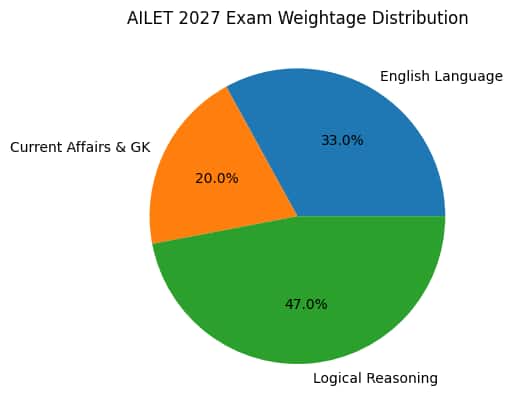
The All India Law Entrance Test (AILET) 2027, conducted by NLU Delhi, is designed to assess a candidate’s proficiency in English Language, Logical Reasoning, and Current Affairs & General Knowledge. The exam consists of 150 questions for 150 marks, with each section carrying a different weightage. Understanding this section-wise distribution of the AILET 2027 Exam Pattern is essential for aspirants to plan their preparation strategically and focus more on high-scoring areas.
Below is the section-wise weightage distribution of the AILET 2027 exam:
Below are the preparation Tips For the AILET 2027 Exam.
Know the Syllabus: Familiarise yourself with all three sections – English, Logical Reasoning, and Current Affairs & GK – and focus on weaker areas.
Create a Timetable: Allocate daily study time for each section, giving more time to challenging topics and regular revision.
Practice Previous Papers: Solve past AILET papers to understand question patterns, improve speed, and build confidence.
Stay Updated on Current Affairs: Read newspapers, magazines, and online sources for national, international, legal, and economic news.
Enhance Legal Reasoning: Practice sample papers and mock tests to strengthen logical and legal reasoning skills.
Improve English Skills: Focus on vocabulary, grammar, comprehension, and verbal ability through reading and practice.
Develop Logical Reasoning: Solve puzzles, syllogisms, analogies, and analytical questions to boost critical thinking.
Take Frequent Mocks: Simulate exam conditions to improve time management, assess preparation, and identify weak areas.
Prioritise Accuracy and Speed: Balance speed with precision; manage time effectively and tackle difficult questions strategically.
On the day of the AILET 2027 Exam, Time Management is the key. Here's how you can approach it:
Section-wise Strategy: Allocate about 20 minutes each for the English, Legal Reasoning, and General Knowledge sections. Spend about 15 minutes on Logical Reasoning and 5 minutes on Mathematics.
First Round Approach: Begin with the sections that you are most confident about, and leave the more time-consuming questions for the last. This helps in managing time effectively.
Subject | Books and study material |
English |
|
Mathematics |
|
General knowledge (Static) |
|
General knowledge (Current affairs) |
|
Legal aptitude |
|
Reasoning |
|
Also Check: AILET Mock Test 2027 by Careers360 - Download Free PDF

On Question asked by student community
Hello,
Since you are reappearing for your Class 12 board exams as a private candidate, you should typically write " Private Candidate " in the column for the school name while filling out the form. Your previous school name is not required in this case because you are no longer
The AILET (All India Law Entrance Test) Mohali merit list for BA LLB is typically released within a few weeks after the exam. The exact date varies from year to year.
After the exam, the National Law University (NLU), Mohali, usually releases a tentative answer key, followed by the declaration
Whether you can register for a 3-year LLB entrance in late May depends on the state and the specific university or entrance exam you are targeting. Each state and university in India has its own schedule and deadlines for law entrance exams. Here's a general guideline:
1. Check the Specific
For law admissions, CLAT and AILET are the primary entrance exams, but they cater to different programs. CLAT is used for admission to BA LLB , BSc LLB , and LLM programs across most National Law Universities (NLUs) . It has separate sections for undergraduate and postgraduate law programs. On
Hello,
As we all know that NLU’s are considered as one of the prestigious institutes in India and that is the main reason of it being considered as the best choice for the students, but overall it is worth because the highest package offered was 19LPA by the NLU Delhi

Among top 100 Universities Globally in the Times Higher Education (THE) Interdisciplinary Science Rankings 2026
North India's Largest Educational Group | NIRF Ranked 87 | NAAC A+ Grade | Highest Package 1.6 Cr | Application Deadline: 20th May’26
Approved by Bar Council of India | 100% Scholarship | Accepts CLAT Scores | Application Deadline: 19th May'26!
Ranked #1 Law School in India & South Asia by QS- World University Rankings | Merit cum means scholarships | Applications Closing Soon
NAAC A+ Accredited | Students | Moot Court Session | Legal Aid Clinics | | Scholarships to Meritorious
In-house judicial coaching | Proven success in National Moot Court Competitions