


Difference Between AIBE and Judiciary Exams for Law Aspirants
AIBE or Judiciary Exams — which path is right for you? While both exams are crucial milestones for law aspirants in India, they serve entirely different purposes and lead to very different careers. From eligibility and AIBE Exam Pattern to career scope, salary, and long-term growth, understanding the difference between AIBE and Judiciary Exams is essential before you plan your next move.

In this article, we break down AIBE vs Judiciary Exams in a clear, exam-oriented way to help law students and fresh graduates make an informed, confident decision about their future in the legal profession.
What is AIBE (All India Bar Examination) 2026?
The All India Bar Examination (AIBE) is a mandatory qualifying examination conducted by the Bar Council of India (BCI) for law graduates who wish to practice law in India. Clearing AIBE is essential to obtain the Certificate of Practice (CoP), which legally authorises a candidate to appear before courts, tribunals, and other legal forums as an advocate.
Purpose of AIBE
AIBE is not a competitive exam. Its objective is to assess the minimum professional competence of fresh law graduates. It ensures that advocates entering the legal profession possess a basic understanding of core legal subjects, ethics, and professional standards.
What are Judiciary Exams in India?
Judiciary Exams, also known as Judicial Services Examinations, are highly competitive state-level exams conducted to recruit candidates as Civil Judges (Junior Division) or Judicial Magistrates in the Indian judicial system. These exams are conducted individually by each state through its High Courts or Public Service Commissions.
Purpose of Judiciary Exams
The primary aim is to select judges for the subordinate judiciary. Unlike AIBE, judiciary exams are career-defining competitive examinations that offer direct entry into the judicial service, a prestigious and constitutionally significant role.
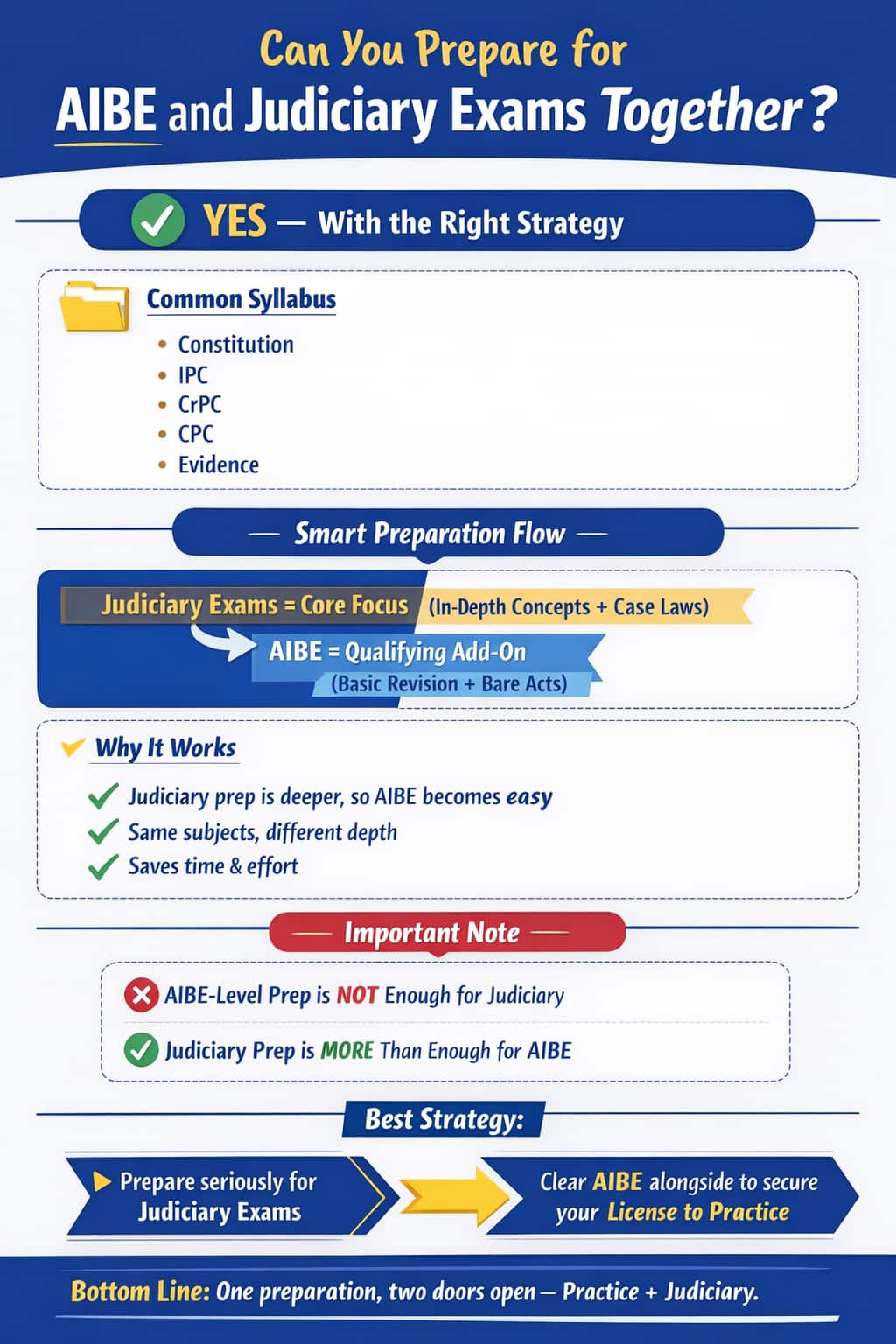
Can You Prepare for AIBE and Judiciary Exams Together?
AIBE vs Judiciary Exams: Exam Pattern & Syllabus Comparison
AIBE is a single-stage qualifying exam, while Judiciary Exams are multi-stage competitive exams with an in-depth syllabus. Given below is a short comparison of the AIBE vs Judiciary Exam.
Aspect | All India Bar Examination (AIBE) | Judiciary Exams |
Exam Pattern | Single-stage exam | Three stages: Prelims, Mains & Interview |
Question Type | Objective (MCQs) | Prelims: MCQs, Mains: Descriptive (answer writing), Interview: Viva voce |
Nature of Exam | Qualifying (no rank or merit list) | Competitive (rank-based selection) |
Book Allowed | Open-book (Bare Acts without notes) | Closed-book |
Syllabus Level | Basic & practical understanding | Deep, analytical & conceptual |
Core Subjects | Constitution, IPC, CrPC, CPC, Evidence, Ethics, etc. | Constitution, IPC, CrPC, CPC, Evidence, Contract, Torts, local/state laws, case laws |
Focus Area | Minimum professional competence | Legal interpretation, judgment writing & application of law |
Difficulty Level | Moderate | High |
Which is Better for Law Aspirants: AIBE or Judiciary Exams?
There is no one-size-fits-all answer—the better option depends entirely on your career goal in law. If you aim to practice law as an advocate, then the All India Bar Examination (AIBE) is non-negotiable. Clearing AIBE is mandatory to obtain the Certificate of Practice, which allows you to appear in courts, join litigation chambers, or work in independent legal practice. AIBE is qualifying in nature, relatively moderate in difficulty, and designed to test basic legal knowledge, not depth or rank.
On the other hand, if your goal is to become a judge, then the Judiciary Exams are the better and only path. These exams are highly competitive and require long-term, disciplined preparation. Success leads to appointment as a Civil Judge or Judicial Magistrate, offering job security, authority, structured career growth, and public service prestige. However, once you join the judiciary, you cannot practice law as an advocate.
Key Note:
Choose AIBE if you want a career in legal practice
Choose Judiciary Exams if you want a career on the bench
Many aspirants also pursue both paths at different stages, depending on how their interests evolve.
Relationship Between the AIBE Syllabus and Judiciary Exams
The All India Bar Examination (AIBE) syllabus andthe Judiciary exam syllabus are closely connected, as both are built around the same core legal subjects. However, the depth, purpose, and level of application of these subjects differ significantly.
Aspect | AIBE Syllabus | Judiciary Exam Syllabus |
Exam Purpose | Tests the minimum professional competence for legal practice | Tests judicial aptitude, legal reasoning, and decision-making |
Level of Study | Basic to moderate | Advanced and in-depth |
Core Subjects | Constitution, IPC/BNS, CrPC, CPC, Evidence, Ethics | Constitution, IPC/BNS, CrPC, CPC, Evidence + case laws, state laws |
Role of Bare Acts | Primary and indispensable source | Foundation plus detailed interpretation |
Depth of Bare Act Reading | Understanding key provisions and structure | Section-wise mastery with interpretation |
Use of Case Laws | Minimal | Extensive and compulsory |
Nature of Questions | Objective (MCQs) | Objective + descriptive + judgment writing |
Overlap Between Syllabi | Forms the base level | Fully includes and expands AIBE syllabus |
Preparation Impact | Sufficient only for AIBE | Automatically covers AIBE preparation |
Reverse Applicability | Not sufficient for Judiciary | More than sufficient for AIBE |
Popular Courses and Specializations
Questions related to AIBE
On Question asked by student community
Hello Dear Student,
The All India Bar Examination (AIBE) covers 19 major legal subjects, carrying a high-weightage focus on Constitutional Law (8–12 questions) and Family Law including Hindu and Muslim law (6–8 questions)
You can check, find and access more information here:
-
https://law.careers360.com/articles/aibe-important-topics
Hope it helps!
Hello Dear Student,
Could you provide more information so that i could help you further!
Hello Venkataharanadh
Please check the link given below for the answer key:
https://law.careers360.com/articles/aibe-answer-key
Hope it helps.
Hello Dear Student,
Could you provide more information so that i could help you further!
Hello Rajnesh
Yes, you have passed the AIBE 21 exam. If you score 46 marks, you meet the minimum qualifying criteria.
You can check the minimum pass requirements for the All India Bar Examination from the link given below:
https://law.careers360.com/articles/aibe-21-passing-marks-2026
Hope it helps.