


CLAT Quantitative Techniques 2027: Topic, Syllabus, Pattern, Question Paper
The CLAT 2027 exam was conducted offline on December 7, 2025, from 2:00 pm to 4:00 pm. A standout feature of CLAT is the presence of the maths section. Mathematics finds its way into the Common Law Admission Test through the Quantitative Techniques for CLAT section. In the CLAT syllabus, the CLAT quantitative techniques section is allotted only a 10% weightage, but it can make a big difference in the candidate's prospects of getting a good rank. The Quantitative Techniques section of CLAT 2027 will feature short sets of facts or textual/numerical information, followed by questions requiring basic mathematical application. The Consortium of National Law Universities (CNLU) has released the official notification and sample papers on its website, consortiumofnlus.ac.in. In this article, get to know about the CLAT Quantitative Techniques syllabus, the quantitative aptitude question paper, and a few preparation tips.
This Story also Contains
- What is Quantitative Techniques in CLAT?
- CLAT Quantitative Techniques Syllabus
- CLAT Quantitative Techniques Important Topics
- CLAT Quantitative Techniques Question Paper Pattern
- Infographics - CLAT Quantitative Techniques Question Paper Pattern
- Preparation Tips for CLAT Quantitative Aptitude

What is Quantitative Techniques in CLAT?
The quantitative techniques in CLAT 2027 test the candidate's basic mathematical ability. It evaluates the candidate's knowledge of basic maths problems, including basic calculations, profit and loss, ratio and proportion, and more. The CLAT quantitative techniques, mathematical operations have a 10th standard difficulty level or below.
CLAT Quantitative Techniques MCQs
CLAT Quantitative Techniques Syllabus
Similar to other sections in the CLAT exam, the CLAT Maths also contains different questions based on a given set of passages or data.
What type of Questions will be asked?
The Consortium of National Law Universities (CNLU) has specified that the quantitative section of the CLAT will cover short collections of propositions or facts, graphs, or other textual, visual, or diagrammatic representations of numerical data. The candidate has to answer the questions that follow this set of data.
It will test the candidate’s ability to:
Obtain, deduce, and alter the numerical data presented in texts, graphs, or any other form.
Perform mathematical operations in various areas. The topics will include basic algebra, ratio and proportion, statistical estimation, and mensuration. The mathematics asked in the exam is of the 10th-grade level
To obtain proficiency in these topics, some of the best books on CLAT Quantitative Aptitude that can help the candidate include the Class 10 NCERT Mathematics Textbook and Quantitative Aptitude by R.S. Aggarwal.
You may also read
CLAT Quantitative Techniques Important Topics
Given below are important topics in the maths section of CLAT 2027.
Basic Arithmetic: This includes fundamental mathematics that covers simple operations such as addition, subtraction, division, and multiplication.
Profit & Loss: This part covers finding out gains or losses incurred in an activity
Ratios and Proportions: Finding out the percentage increase or decrease and the mathematical relationship between two given situations
Mensuration: It deals with measurement, volume, and geometry.
Statistical Estimation: It covers analysing a given set of data and interpreting results
You may also check
CLAT Quantitative Techniques Question Paper Pattern
| Particulars | Details |
Weightage | 10% |
Number of Questions | 10-14 MCQs |
Marks | 10-14 |
Negative Marking | -0.25 |
Infographics - CLAT Quantitative Techniques Question Paper Pattern
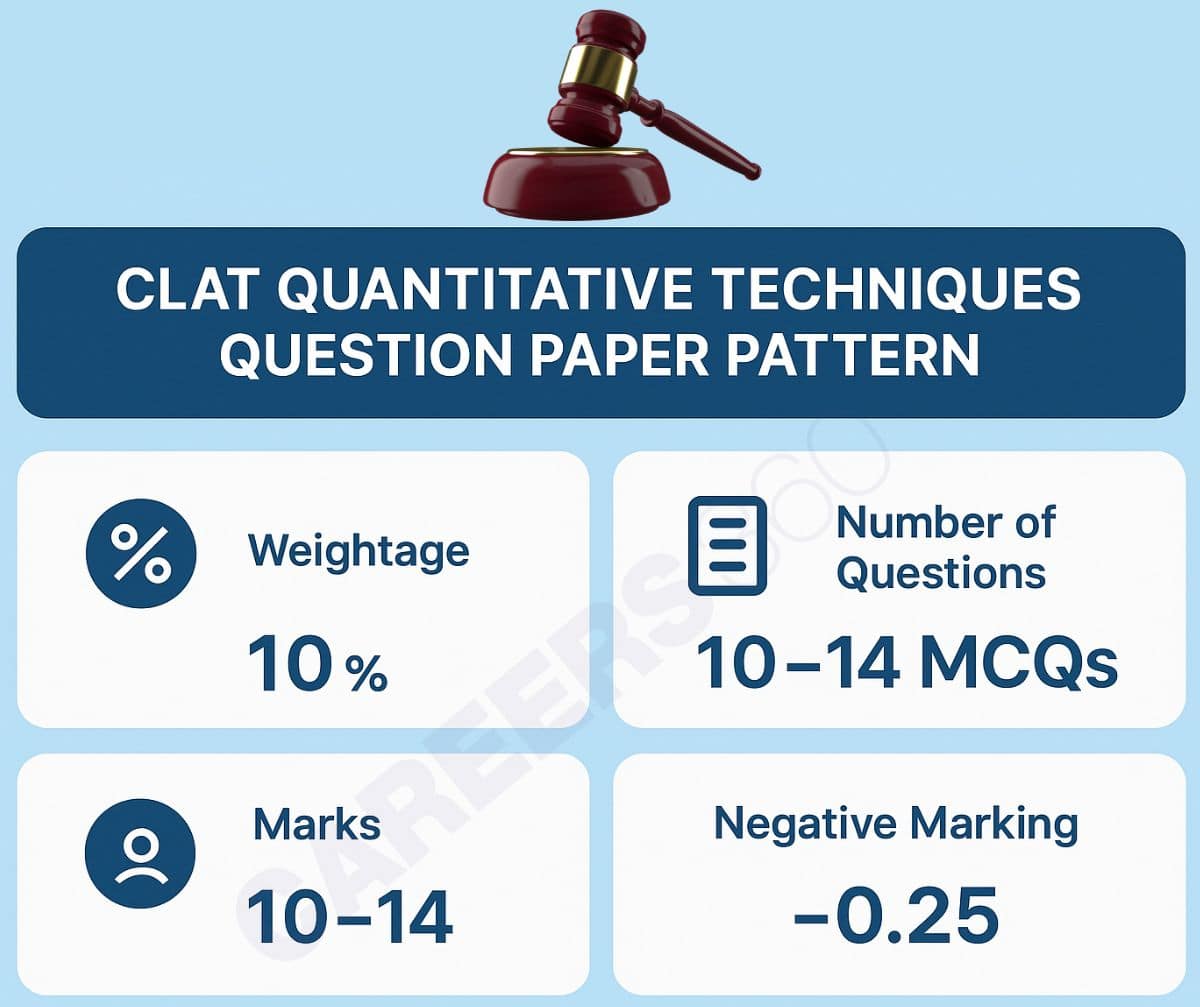
The quantitative section contains 10-14 multiple-choice questions, which is approximately 10% of the overall paper. Although the weightage given to the quantitative techniques for CLAT is less than the 20% weightage for other sections, it is of no less significance.
Candidates would do well to practise adequately through previous year CLAT question papers and CLAT sample question papers released by the CNLU to acquaint themselves with the CLAT paper pattern.
Here’s a question given below, which is extracted from the official UG-CLAT 2023 paper. Attempt it to find out your comfort level in the section.
World fruit production went up 54 per cent between 2000 and 2019, to 883 million tonnes. Five fruit species accounted for 57 per cent of the total production in 2019, down from 63 per cent in 2000. Use the data in the passage to answer the following questions
What was the world fruit production in 2000?
(A) 474 million tonnes
(B) 517 million tonnes
(C) 573 million tonnes
(D) 406 million tonnes
Of the five fruit species mentioned in the passage above, the share of bananas and plantains increased by 1 percentage point between 2000 and 2019, watermelons in 2019 was 6 percentage points lower than bananas and plantains in 2000, apples remained stable at 10%, and the percentage share of oranges and grapes reduced to half of bananas in 2019. What was the percentage of bananas and plantains in 2019
(A) 17%
(B) 18%
(C) 16%
(D) 21%
Of the watermelons in 2000, one-eighth perished, one-fifth of the remaining was sold to be juiced and 30% of the remaining was exported. If the percentage share of oranges in 2000 was equal to the percentage share of watermelons in 2019, how many watermelons were retained for home sale and consumption?
(A) 39.2 million tonnes
(B) 1.6 million tonnes
(C) 16.8 million tonnes
(D) 2.7 million tonnes
Assume that all grapes and apples were sold through a single organisation in 2000. Grapes and apples were sold to 4 different customers such that a certain quantity of apples were sold to the first customer, the same number of apples were sold to the second customer as to the first and a certain number of grapes were sold to that customer after which the apples were over. Twice the quantity of grapes sold to the second was sold to the third customer and twice the quantity sold to the third was sold to the fourth customer. The total quantity of grapes is equal to the total quantity of apples sold and the remaining grapes were stored. How many grapes were sold to each customer?
19.1 million tonnes
8.2 million tonnes
28.6 million tonnes
9.4 million tonnes
Frutopia and Fruitfix both sold oranges at the same selling price. However, Frutopia gave customers a 15% discount on the marked price, whereas Fruitfix sold the oranges for a discount of 20% on the marked price. If the marked price of oranges on Frutopia is 75/kg, what is the marked price of oranges on Fruitfix?
(A) 78
(B) 82
(C) 90
(D) 80
CLAT Quantitative Techniques Books
Given below are some good books for quantitative techniques for CLAT 2027
| Quantitative Aptitude for Competitive Examinations | R.S. Aggarwal |
| Mathematics for Class 10 | NCERT |
Preparation Tips for CLAT Quantitative Aptitude
Candidates can find it difficult to prepare for the quantitative section in CLAT. However, it may not be as difficult as it seems. It requires continuous practice to ace the mathematics section because of the very nature of the subject. If candidates follow a study timetable and solve enough CLAT quantitative aptitude sample papers and mock tests, then they find this section easy. Candidates must also work on their reading and comprehension speed to succeed in this part. The questions can often be descriptive in nature, and with a superior ability to read and understand, one can get through the section quickly. Similarly, a few shortcuts and tricks to solve numerical problems can boost calculation speed to complete the section quickly.
Also, check -
Frequently Asked Questions (FAQs)
This section contains questions based on 10th grade level maths and includes topics such as basic algebra, ratio and proportion, mensuration and statistical estimation.
The quantitative aptitude section has 10-14 questions forming roughly 10% of the overall syllabus.
Yes. Though the weightage for the quantitative section is 10%, doing well in it can improve your chances of getting ahead of the competition.
Candidates can refer to class 10 NCERT mathematics textbook and also Quantitative Aptitude by RS Aggarwal. Solving sample papers and earlier question papers should also be part of one’s preparation.
The quantiative techniques in CLAT is a test of the candiadate's basic mathematical ability to peform basic mathematical calculations and work with numerical data.
Popular Courses and Specializations
Popular Degrees
Questions related to CLAT
On Question asked by student community
To calculate the arithmetic mean, you can add up all the values and divide them by the number of items.for the calculation you need the value of sales everyday add them and then divide it by 7 if sunday is included in it or the working days of the week
There are many offline and online coaching for CLAT uG preparation, there are several reputable institutes that stand out. One of the top choices is legalEdge, career launcher,time they all known for its comprehensive study materials and experienced faculty members who provide personalized guidance to students, structured program with regular
hello aspirant,
The secret to passing the exam is consistent practice, which may be achieved by working through sample papers, mock exams, and prior years' CLAT question papers. Practice as much as you can; it will help you feel more confident and more like an actual test. This a very
Hello aspirant,
IF you want to score good marks in CLAT the following a well planned study timetable is a very basic requirement. Along with this you need to highlight your weak areas so that you can focus more on them.
Also try to read english newspaper daily to improve
Hello,
Here are the links where you can get information about CLAT exam and also study material offered by careers360 :
1. CLAT 2025 information and how to prepare :
https://law.careers360.com/articles/how-prepare-for-clat
2. Study material :
- https://law.careers360.com/articles/best-books-for-clat
Hope it helps !