
ICFAI-LAW School BA-LLB / BBA-LLB Admissions 2025
Ranked 1 st among Top Law Schools of super Excellence in India - GHRDC | NAAC A+ Accredited | #36 by NIRF
The Consortium of NLUs (CNLUs) will prescribe the CLAT logical reasoning syllabus 2026 on its official website consortiumofnlus.ac.in. The CLAT 2026 logical reasoning syllabus tests the candidate’s logical and critical thinking skills, essential for anyone in the legal profession. The CLAT logical reasoning section will have a 20% weightage in the CLAT syllabus 2026. Questions in the syllabus of CLAT logical reasoning 2026 will be based on underlying passages.
This Story also Contains

CLAT 2026 is scheduled to be conducted in the second week of December 2025, in offline mode. There will be 22-26 multiple-choice questions based on underlying passages from the CLAT logical reasoning syllabus 2026 in the exam. Through the Common Law Admission Test, candidates will be admitted into 5-year LLB programmes of CLAT colleges participating in the exam.
| Particulars | Details |
|---|---|
Section Weight | 20% |
Number of questions | 22-26 |
Type of questions | Objective-type questions based on passages |
Skills tested | Logical and critical thinking |
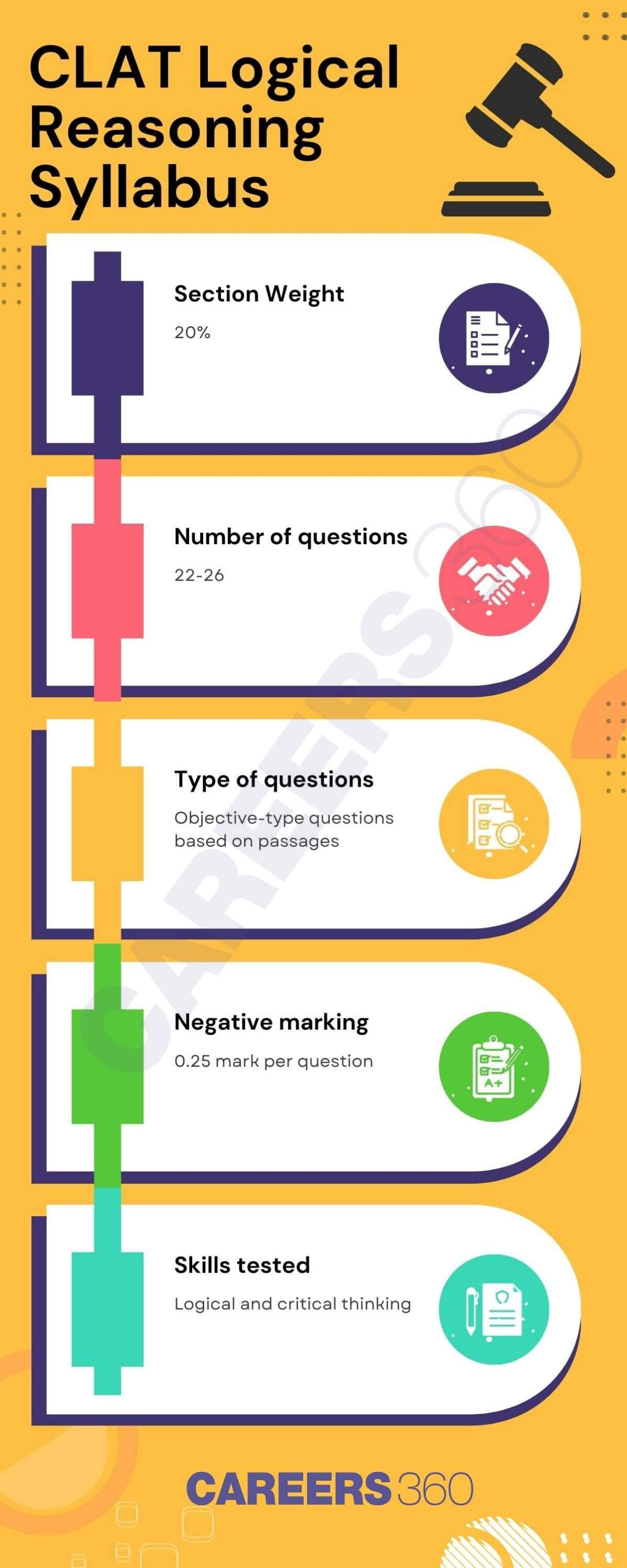
Like other sections in the exam, the logical reasoning syllabus for CLAT 2026 will have multiple-choice questions based on underlying passages. There will be 2-4 passages of 450 words each. Candidates are required to apply critical thinking to solve questions based on the passage.
The topics in the CLAT syllabus for Logical Reasoning are explained in detail below:
Drawing Analogies: Making comparisons between two fact scenarios or arguments and identifying their similarities and differences.
Conclusions and Inferences: Drawing logical inferences and conclusions from given statements
Premises and Assumptions: Identifying the assumptions and premise in given statements and predicting the likely result.
Cause and Effect: Identifying the likely factors that have led to a certain outcome or result and studying the cause and effect relationships between the situations.
The syllabus of CLAT 2026 logical reasoning will evaluate the following skills in the candidates:
Identify arguments, their underlying assumptions, and logical conclusions
Identify patterns of reasoning present in different arguments
Study the underlying premises in arguments and see how the argument can be strengthened or weakened by altering the premise or assumptions
Draw conclusions from given arguments or situations and apply them to new situations
Compare and contrast different arguments
Candidates can follow the tips given below to prepare for the syllabus of CLAT logical reasoning-
Candidates must work on strengthening their analytical skills by repeatedly engaging in solving problems and puzzles that require critical thinking.
One can make use of diagrams and charts to visualise problems and the likely solutions thereof.
The questions must be answered based on the information given and candidates must not make any unnecessary assumptions outside of the given arguments.
Practising with previous year's CLAT question papers can help candidates know the type of questions to expect in the exam and prepare well.
Candidates must work on utilising the given time effectively. Solving problems and puzzles can be time-consuming, so candidates must plan and allocate time as per their level of preparation to score maximum marks in the exam.
Reading and comprehending the information accurately is very important in order to solve the problem correctly. Candidates must work on improving their reading and comprehension skills by engaging in regular reading habits through which they can grasp the assumptions and premise in the given statements fairly quickly.
Finally, candidates must refer to good books on CLAT logical reasoning to build a sound conceptual understanding to solve the problems.
Given below is a list of books for the CLAT logical reasoning 2026 syllabus. The list is not exhaustive and candidates must consider various factors such as the author, publication, syllabus followed and availability of practice question papers before finalising the books.
Sl. no | Books |
|---|---|
1 | How to Crack Test Of Reasoning by Arihant Experts |
2 | Analytical Reasoning by MK Pandey |
3 | A New Approach to Reasoning Verbal & Non-Verbal – B.S. Sijwali & Indu Sijwali |
4 | A Modern Approach to Logical Reasoning by R S Aggarwal |
You may also check other subjects syllabus:

On Question asked by student community
hello aspirant,
The secret to passing the exam is consistent practice, which may be achieved by working through sample papers, mock exams, and prior years' CLAT question papers. Practice as much as you can; it will help you feel more confident and more like an actual test. This a very
Hello aspirant,
IF you want to score good marks in CLAT the following a well planned study timetable is a very basic requirement. Along with this you need to highlight your weak areas so that you can focus more on them.
Also try to read english newspaper daily to improve
Hello,
Here are the links where you can get information about CLAT exam and also study material offered by careers360 :
1. CLAT 2025 information and how to prepare :
https://law.careers360.com/articles/how-prepare-for-clat
2. Study material :
- https://law.careers360.com/articles/best-books-for-clat
Hope it helps !
Hello,
Yes, Hindi medium students are eligible to appear for most entrance exams, including those for higher education or competitive exams, provided they meet the other eligibility criteria like educational qualifications. Many exams offer question papers in Hindi, especially for state and national-level exams like UPSC, NEET, JEE, and law
Hey there! Thanks for reaching out to Careers360. Glad to hear you're interested in using our CLAT college predictor too l. It's definitely a handy resource for CLAT aspirants.
To use the predictor, just head over to our website and look for the CLAT section. You'll need to input your

Admissions open for B.A. LL.B. (Hons.), B.B.A. LL.B. (Hons.) and LL.B Program (3 Years)
Grade 'A+' accredited by NAAC
Ranked #1 Law School in India & South Asia by QS- World University Rankings | Merit cum means scholarships | Application Deadline: 31st Jan'25
Ranked #28 amongst Institutions in India by NIRF | Ranked #1 in India for Academic Reputation by QS University Rankings | 16.6 LPA Highest CTC
Ranked #1 Among all Private Indian Universities in QS Asia Rankings 2025 | Scholarships worth 210 CR
India's youngest NAAC A++ accredited University | NIRF rank band 151-200 | Approved by Bar Council of India