Jindal Global Law School Admissions 2026
Ranked #1 Law School in India & South Asia by QS- World University Rankings | Merit cum means scholarships | Applications Closing Soon



Preparing for TS LAWCET 2026 becomes easier when you focus on the topics that are frequently asked in the TS LAWCET Examination. Instead of studying the entire syllabus randomly, students can improve their scores by prioritising high-weightage and commonly repeated concepts. In this article, we highlight the most asked topics for TS LAWCET 2026 based on previous year question paper trends to help students plan their preparation effectively and score better in the exam.

Before beginning with the TS LAWCET Preparation journey, let's get thorough Prospective candidates should acquaint themselves with the exam pattern of TS LAWCET 2026, which is outlined as follows:
The exam will be conducted online.
The test language is in English and Telugu.
The examination time will be 1 and a half hours.
The question type will be objective-type questions.
The paper will consist of 120 questions.
Scoring: Each correct answer will earn candidates 1 mark.
Negative Marking: The exam will not have any negative marking.
The TS LAWCET syllabus consists of 120 multiple-choice questions divided into three sections: Current Affairs (30 questions), General Knowledge (30 questions), and Aptitude for Study of Law (60 questions). Each question carries 1 mark, and there is no negative marking.
Among these sections, Aptitude for Study of Law holds the highest weightage with 50% of the total questions, making it the most important section for candidates preparing for the exam. Understanding this distribution helps students plan their preparation and focus more on high-weightage areas.
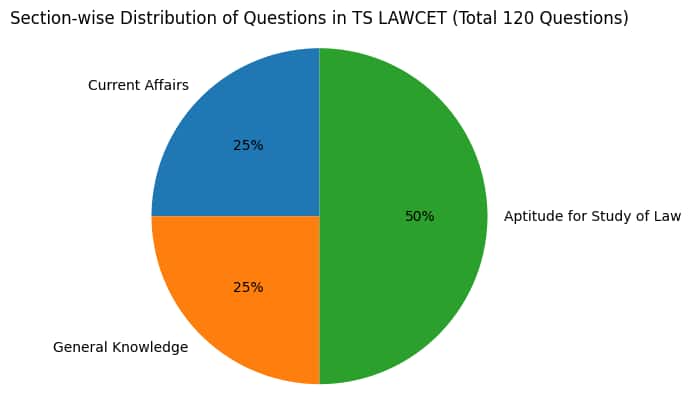
The TS LAWCET question paper consists of 120 multiple-choice questions divided into three sections. Each question carries 1 mark, and there is no negative marking. Understanding the data-based distribution of questions helps students focus on the most important topics during TS LAWCET 2026 Preparation.
This section mainly focuses on recent national and international events. Based on previous year trends, most questions are asked from the following areas:
National Current Affairs – 8 to 10 questions
International Events & Organisations – 4 to 6 questions
Government Schemes & Policies – 3 to 5 questions
Awards & Honours – 2 to 3 questions
Sports News – 2 to 3 questions
Important Summits & Conferences – 2 to 3 questions
Ranked #1 Law School in India & South Asia by QS- World University Rankings | Merit cum means scholarships | Applications Closing Soon
Among top 100 Universities Globally in the Times Higher Education (THE) Interdisciplinary Science Rankings 2026
This section evaluates static GK and basic awareness about India and the world. Previous exam analysis shows the following distribution:
Indian History & Freedom Movement – 5 to 7 questions
Indian Geography – 4 to 6 questions
Indian Polity & Constitution Basics – 5 to 6 questions
Science & Technology – 3 to 4 questions
Important Days, Books & Authors – 3 to 4 questions
Miscellaneous GK – 4 to 5 questions
This is the highest-weightage section, testing candidates’ legal reasoning ability and understanding of legal principles. Data from previous papers suggests the following pattern:
Legal Reasoning & Principle-Fact Questions – 20 to 25 questions
Legal Terms & Legal Maxims – 8 to 10 questions
Basic Constitutional Law – 8 to 10 questions
Important Landmark Judgements – 5 to 7 questions
Assertion–Reason-Based Legal Questions – 5 to 6 questions
Basic Legal Facts & Concepts – 5 to 7 questions
Last Date to Apply: 30th May | Ranked #18 amongst Institutions in India by NIRF | Ranked #1 in India for Academic Reputation by QS Rankings | 16 LPA Highest CTC
NAAC A++ Approved | Curriculum Aligned with BCI & UGC
By focusing on these high-frequency topics, candidates can strategically prepare for TS LAWCET 2026 and maximise their chances of scoring higher in the exam.
Here are some useful tips to prepare effectively for the TS LAWCET:
Understand the Exam Pattern: Although the 3-year LLB and 5-year LLB exams may appear similar, their difficulty level and question focus can differ. Prepare according to the specific exam you are appearing for.
Create a Proper Study Plan: Make a well-structured study timetable and allocate time to each section based on its weightage in the syllabus. This helps in maintaining a systematic preparation approach.
Use Smart Guessing: Since there is no negative marking, candidates can use the process of elimination to make smart guesses and increase their chances of answering more questions correctly.

On Question asked by student community
It is quite difficult to get top law colleges at this score even not the lowest cutoff university will allow students to pursue law at this score but lets hope for the best try college like kalatiya university college of law and Mahatma Gandhi law college which has low cutoff.
You are on a border line which is very close to last years cutoff at kalatiya university college of law and Mahatma Gandhi law college belonging to bc-e category you might get seat here if cutoff trends is same as last year but definitely you are not going to get
Based on your situation, it seems there may have been some confusion regarding the eligibility criteria for non-local candidates in TS LAWCET. Generally, for state entrance exams like TS LAWCET, "non-local" candidates are those who are not residents of the state but have fulfilled specific residency requirements, such as living
Hello
Congratulations on your TS LAWCET rank!
With a rank of 294, you have a good chance of getting a seat in the 5-year BALLB program at Osmania University through the Non-Local (NIQ) quota.
Osmania University has a total of 120 seats in the 5-year BALLB program, with 30% reserved
With a 14th rank in TS LAWCET (Telangana State Law Common Entrance Test) but being from Andhra Pradesh (AP), here’s what you should consider regarding admission to Osmania University:
1. Local vs. Non-Local Quota: Osmania University has a local and non-local quota for admissions. As you are from AP, you

Among top 100 Universities Globally in the Times Higher Education (THE) Interdisciplinary Science Rankings 2026
Approved by Bar Council of India | 100% Scholarship | Accepts CLAT Scores | Application Deadline: 19th May'26!
North India's Largest Educational Group | NIRF Ranked 87 | NAAC A+ Grade | Highest Package 1.6 Cr | Application Deadline: 20th May’26
NAAC A+ Accredited | Students | Moot Court Session | Legal Aid Clinics | | Scholarships to Meritorious
Ranked #1 Law School in India & South Asia by QS- World University Rankings | Merit cum means scholarships | Applications Closing Soon
In-house judicial coaching | Proven success in National Moot Court Competitions